

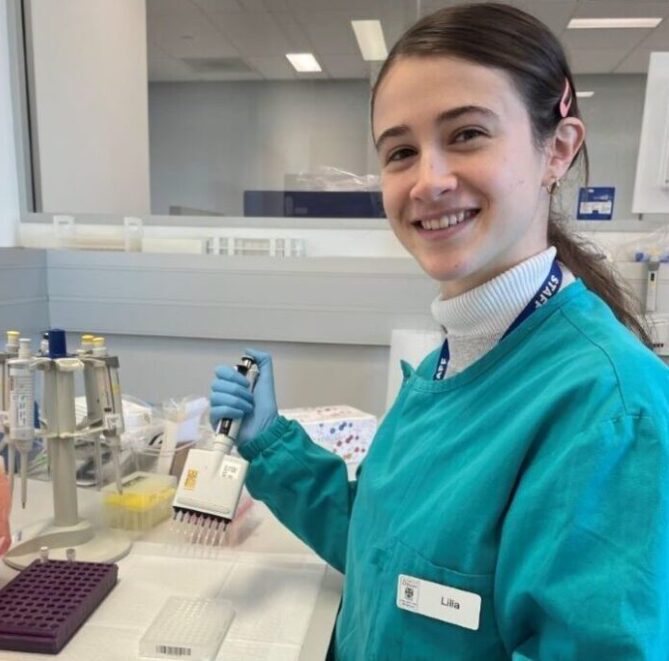
Awanui Labs is providing tomorrow’s scientists direct, practical experience working in a diagnostic laboratory.
In this article on student placements, Lilia Aknine shares her experience on being with the Molecular laboratory at Wellington Regional Hospital, as part of her Bachelor of Medical Laboratory Science degree at the University of Otago.
Lilia Aknine describes one of her first impressions of Awanui Labs as ‘machine learning’.
“I was nervous but excited when I started my placement and was not sure what to expect. The classroom teaches the fundamentals and the theory behind everything, but it is structured learning so being the real laboratory is very different,” says Lilia.
“For me, the lab is machine learning because of all the automation and technology. I was learning to set up the analysers, programme computers to run the tests, and understand the many variations of results from different patients.
“The pace of work was also something I noticed very quickly. Tasks are spaced out with extra time for learning at university, but the lab is processing high volumes of samples and while some days are busier than others, it all must get done in a working day.
One of the big positives for Lilia is the staff at Awanui being supportive, knowledgeable, and willing to teach and help her understand how things are done.
“It has been great because being allowed to do things is how I learn, and I am always supported by my colleagues who share their knowledge, and ways of doing things, for completing tasks. When you come on a placement, it is important to be open to different ideas, approaches and what works best.”
“Awanui Labs’ workplace collaboration with University of Otago and Auckland University of Technology bridges study and practical learning,” says Awanui Head of Organisational Capability, Heather Compton.
“The placements are a core part of the students’ course requirements, collaborating with teams in different laboratories, matching their specialist disciplines which Awanui provides across the country.
“This not only builds technical skills but also strengthens critical thinking, communication and an understanding of quality, safety, and regulatory standards which underpin the work happening every day in the laboratory.”
Lilia says her experience has shown the importance of quality control, and while students are taught this at university, she could see how essential it is to run controls with every batch of samples for accurate patient results and safety.
She also says of the different stations in the molecular lab, the Haematology station can be the most challenging.
“I think they left this one to last as you are learning about a new test, some rare mutations, and cancers almost every day and must remember the process for each of them. This required constant and careful attention to detail, and once again, everyone was there to explain the principles and purpose of each assay.
“Overall, my placement exceeded my expectations and by observing, listening and learning from who I have worked with, this experience has really opened my eyes and definitely confirmed how much I want a career in the lab.”